Astronomy: reports

Hunt for Northern Lights: Norway 2014

Shooting auroras was one of the (few 😀 ) things still missing from my hardcore amateur astronomer checklist. Back in 2012 and 2013 some friends of mine, among whom Lorenzo Comolli, had gone on aurora-chasing trips with very encouraging results. The auroral activity is not always present, or, better, it is rather frequent but highly unpredictable, with a higher probability of events in the years around solar activity maximum and in the months around the equinoxes (February, March, September and […]

The Comet Lovejoy Saga

During the last bit of 2013, comet ISON was not the only comet visible Thank God, I’d say, because ISON turned out to be a real dud. Around late November there were four comets visible in the sky at the same time, the brightest of the pack being Comet C/2013 R1 Lovejoy, that went on to put on a really good show. Discovered on September 7 by Australian amateur astronomer Terry Lovejoy, this comet kept visible during the second half […]

Looking back at comet ISON

Discovered in September 2012 by two Russian Astronomers (Vitali Nevski and Artyom Novichonok) with the 40-cm reflector of the International Scientific Optical Network (ISON) at the Observatory of Kislovodsk (Russia), this comet soon catches the attention of the scientific community, because its perihelion is expected very close to the scorching solar surface at 0.012 AU, i.e. less than 2 million km. From the comet’s path and brightness curve in the months following its discovery, some people suggest that it might […]

The Total Lunar Eclipse of June 15, 2011

On June 15th, 2011, our Solar Systems giant clockwork treated us once again to a very beautiful event: a total lunar eclipse. It had been three years since one such eclipse was visible in Northern Italy back in February 2008. In this case, the local circumstances would favor Central Asia and Eastern Europe, while the situation would be worse for Northwestern regions. In particular, over Northern Italy totality would start just a few minutes after moonrise, and anyway the entire […]

July 22, 2009 – The Eclipse of the Dragon

In 2009, my eclipse chaser activity takes me to Eastern Asia, where the longest (max. duration of 6m 39s) total solar eclipse of XXI century is due to take place. This would also bring my total count of observed eclipses to five: August 1st, 2008 in Siberia (detailed report here), March 29, 2006 in Egypt, (detailed report here), October 3rd, 2005 in Spain (annular: detailed report here), August 11, 1999 in Hungary. This time, the totality path starts over Western […]

Comet C/2007 N3 Lulin

Discovered in the summer of 2007 by some Chinese astronomers, the comet Lulin wasnt expected to make the headlines: however, it was very well placed for observation from the northern hemisphere. In September 2008, observation led to think that it could brighten up to magnitude 4 in late February 2009, when it visibility would also be at its best. Shortly after solar conjuction, after Xmas 2008, the new brightness estimates led to a lower maximum expected brightness of mag. 5.5-6, […]

01 August 2008: The Solar Eclipse visits Siberia

One, two, three and four! Four as the number of eclipses I’ve observed so far in my life: this one took place in Siberia. As you’ll see, it’s been no easy task, but at the end of the day what really counts is that it turned out to be a great success, whose memories will last for a long time. The Aug 1, 2008, solar eclipse was the my fourth one, taking into account only the eclipses Id seen the […]

The Saturn occultation of May 22nd, 2007

On May 22nd, 2007, a Saturn occultation was expected, with much more comfortable time and observing conditions than the previous one of March 2nd, 2007, which I had missed because of some stupid problems with my equipment.

Total Lunar Eclipse of March 3rd, 2007

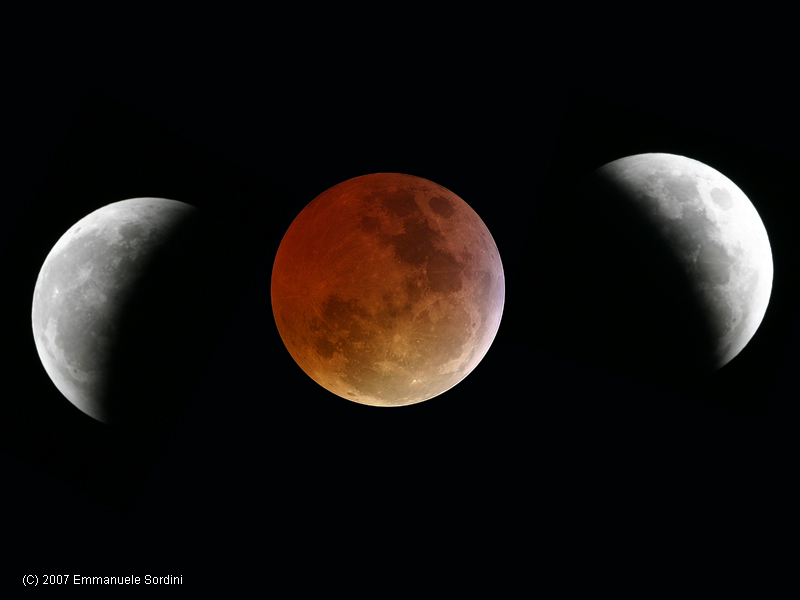
On March 3rd, 2007, a total lunar eclipse took place with very comfortable timing for Western Europe: starting at about 9.30pm local time, maximum eclipse right after midnight, with the last contact with Earth’s umbra around two o’ clock in the morning. The map below shows all parameters for the event. (Please note that all times in this article, except for the map from NASA, are in Central European Time, or GMT+1h).

29 March 2006: The Sun turns black over Egypt!

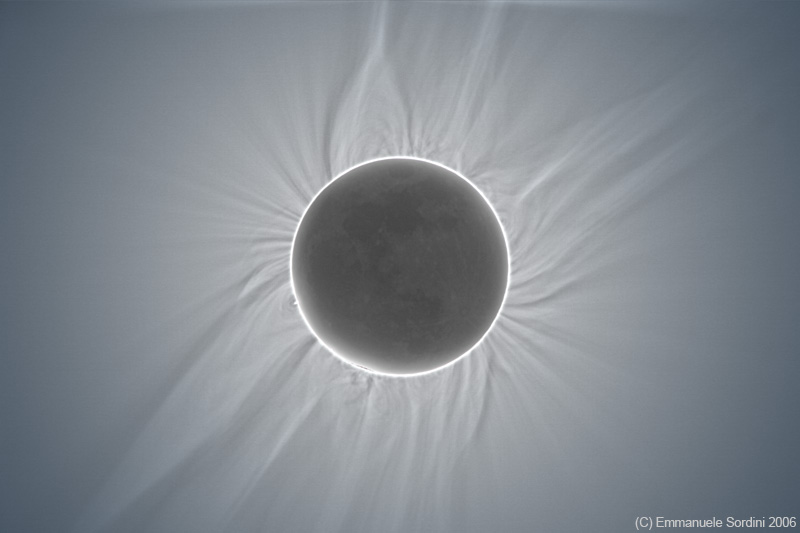
Six months after the October 3rd, 2005, annular eclipse (see the complete report), here comes a total eclipse, the second in my observing record after the last one of the 20th century (1999). This time, the Moon’s shadow path starts in eastern Brazil, quickly dives into the Atlantic Ocean and touches back ground in Africa on the shores of Ghana. Then, it cuts its way through the African continent from SW to NE across the Libyan desert and skims Egypt’s […]

Caricamento...