
 Italiano
 EnglishItalianoEnglish
I recently purchased an Svbony SV605CC CMOS color camera, a relatively cheap model built around the Sony IMX533, a 9-megapixel sensor with a square form factor. Although 2026 has not started out right weather-wise in Northern Italy, among other things I wanted to test this camera out with my Touptek Stellavita. Like other models (e.g. ZWO, Touptek, ecc.), the Svbony offers a low-read noise mode, which makes it possible to maximize exposure latitude (also called “dynamic range”).
Depending on manufacturer and driver implementation, there are normally two ways in which the low-noise is turned on:
For example, Touptek cameras use the former approach, while the latter is adopted for ZWO cameras. The Svbony SV605CC also uses the latter, as described in this post on CloudyNights.
An additional problem is that drivers usually do not allow setting the gain value in actual units (e-/ADU), but instead provide a control (such as a slider) to set the gain value on an arbitrary scale, with ranges greatly varying between cameras and brands and even operating systems..
The Svbony SV605CC can be controlled in Windows through its ASCOM driver, while when used with a Touptek StellaVita mini PC (which is basically a customized version of Raspberry Pi running Linux) the INDI driver is used. At the time of writing (January 2026), the Touptek StellaVita works just fine with the SV605CC and its INDI driver.
To confirm the arbitrary nature of the scale, the gain range for the SV605CC in Windows is between 0 and 600, while in the StellaVita app it can be set anywhere between 0 and 100. With reference to the above mentioned CN thread (post #28), a forum user reported that a gain value of 100 will trigger the low noise mode in Windows.
Therefore, I wanted to try and answer the following question: what is the gain value (in the 0-100 range) that will trigger the low-noise mode in the StellaVita app?
To this end, I acquired a set of flat and bias frames for gain values between 0 and 100 in 5-unit increments (yielding 21 data points) and I measured read noise through this procedure and formula described on Christian Buil’s website.
The two plots below depict the actual value of gain (in e-/ADU) and read noise (in e-) vs. gain values on the arbitrary scale of StellaVita’s driver. Read noise is around 1.78 e- at gain 15, and about half that (0.88 e-) at gain 20.
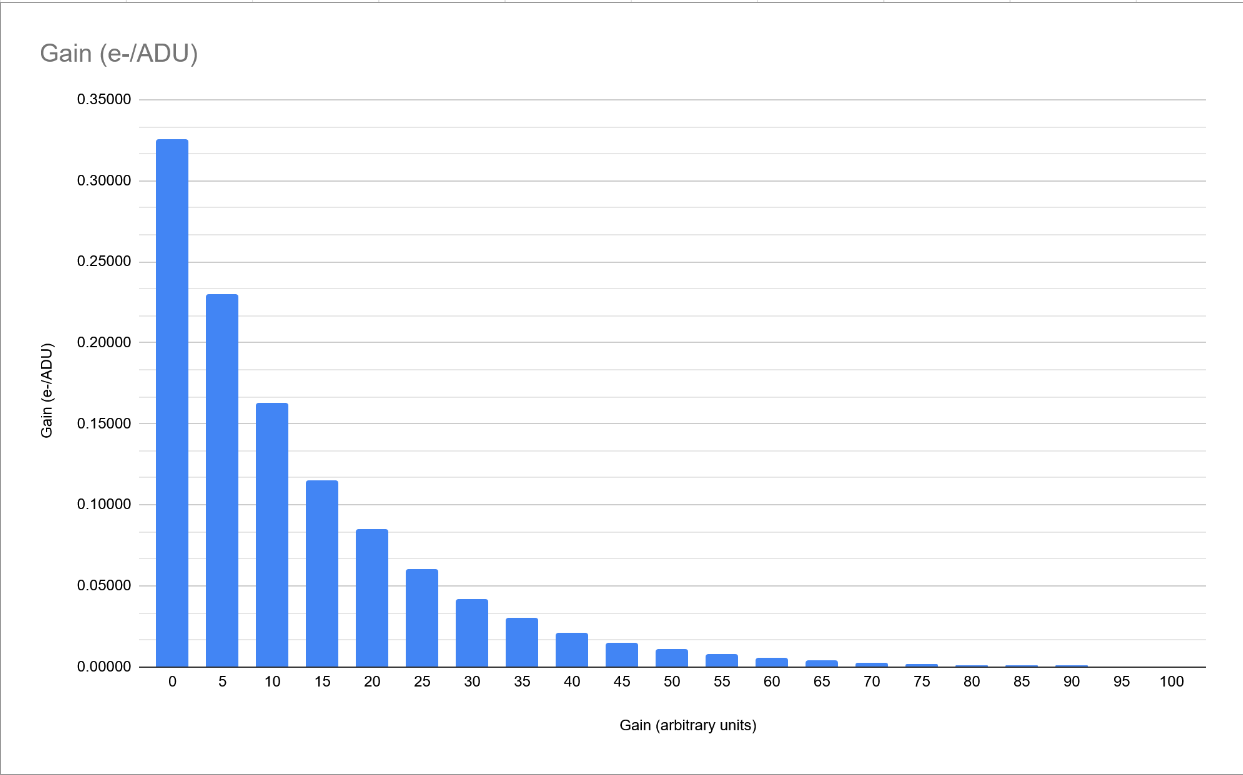
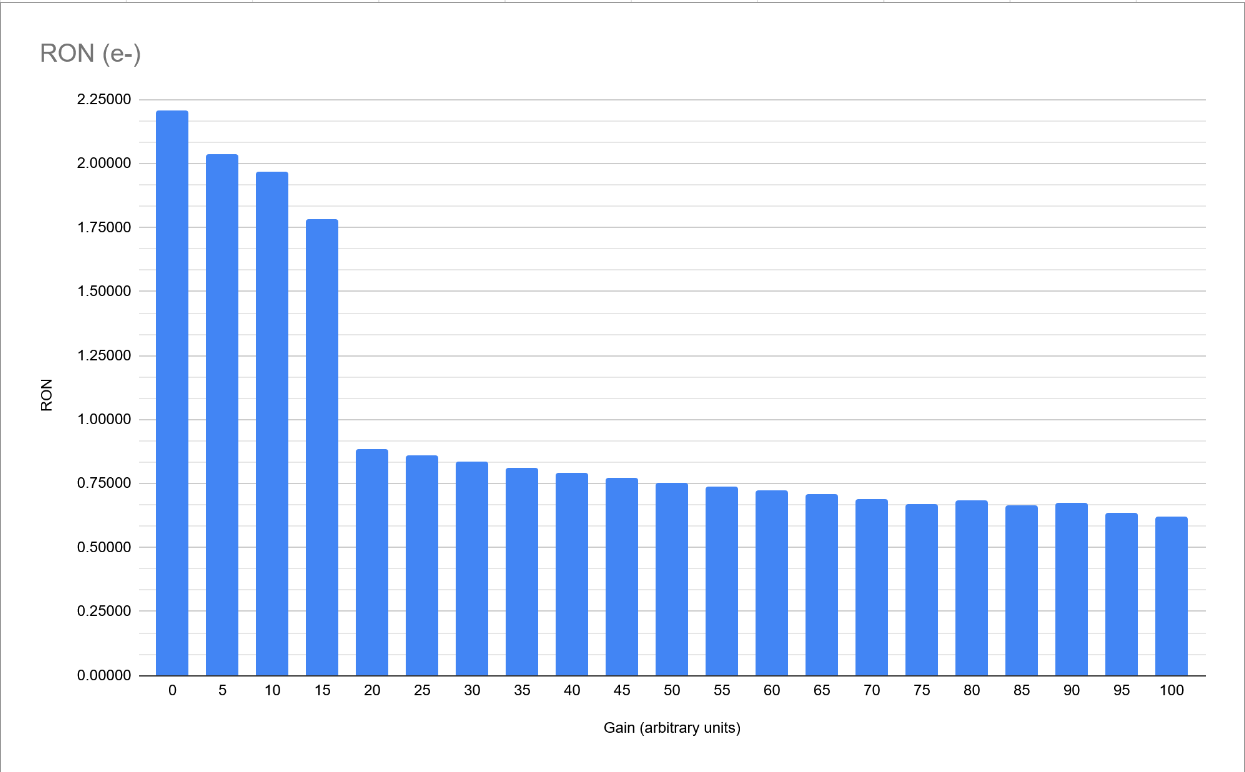
I didn’t test finer gain increments, but I think it can be said that by setting gain to 20 we can cut down read noise, which is always beneficial for dynamic range (“DR”). The figures show that turning up gain above 20 will further decrease read noise (“RON”), albeit only marginally. However, CMOS cameras typically behave in such a way that full-well capacity (“FWC”) also decreases rapidly at higher gain. Knowing that
DR = FWC/RON
If FWC decreases more rapidly than RON as gain increases, this will result in lower dynamic range and therefore no real advantage. To sum up: my advice is to set gain to the smallest value that produces the sharp read noise drop-off (that is, 20).
Update 10 March 2026: the same settings should also apply to the latest release of the StellaVita App (v 2.0).
Hello,
I`ve just had my first light with Stellavita and SV605CC and assumed that I need a linear factor of 1/6 for gain settings. So I first set to a low gain hopiong to get the optimal point. But it was too low and I had problems to focus and platesolve. So I set the gain to 75 for platesolve and TPPA and forgot to set it back during exposure plan. I finally got a bad SNR on my 120s frames.
Now I`ve found your analysis here and will try it wit gain 20 or maybe 19 to hit the 101 ;).
Hope that Touptek will update to a more appropriate driver for the SVBony cams in future.
Further strange behaviuor was that the I was not able to get a proper Autofocus with the Gemini EAF.
I have to check the settings again.
May I need to set reverse move or something else.
Manual focus was with EAF worked so far.
CLS
Andreas
Hello, thanks for your feedback. I cannot comment about the EAF as I focus manually with my rig (it’s fully manual telephoto lens and I didn’t bother installing a motorized focuser with a belt…). As for the gain, however, I’ve found 20 to work just fine.
I know StellaVita has its shortcomings, however being an open platform not limited to one specific brand like ASIAir is a big plus IMHO.
Clear skies!
Emmanuele