
By Emmanuele Sordini
Astronomy: images / Astronomy: website and activity updates
20 January 2015
0

 English
 ItalianoEnglishItaliano

Imaging the Sun in a very narrow band centered on the h-alpha emission line (656.3 nm) yields some of the most stunning images of our star, which show a wealth of details and features on the solar surface which are not visible in white light. I have recently built a so-called “modified PST” solar telescope from a used Coronado PST. The instrument is still “work in progress” and I will most likely report on its construction in another article. I […]

As everybody knows, the fall Milky Way offers several among the most beautiful objects in the northern hemisphere sky. Most often, the attention will focus mainly on the most prominent objects, such as the Double Cluster in Perseus, the Heart Nebula, the California Nebula, etc. However, there are a host of less famous objects (open clusters, nebulae, etc.) which are real gems. The constellation of Cassiopea, despite its small size, is full of such gems. These objects, if taken individually, […]

The 2014 opposition of Mars was due to take place in mid-April, with the planet in the constellation Virgo at a declination of about -5 degrees. Mars was expected to peak at -1.5 magnitudes with a maximum diameter of 15.1 arcseconds. For Northern Italian mid latitudes (~ 45 degrees N), this yields a maximum height of 40 degrees at the local meridian. Considering the average seeing conditions in the area, the geometric circumstances were not super-favorable, but nevertheless fair enough […]

Shooting auroras was one of the (few 😀 ) things still missing from my hardcore amateur astronomer checklist. Back in 2012 and 2013 some friends of mine, among whom Lorenzo Comolli, had gone on aurora-chasing trips with very encouraging results. The auroral activity is not always present, or, better, it is rather frequent but highly unpredictable, with a higher probability of events in the years around solar activity maximum and in the months around the equinoxes (February, March, September and […]
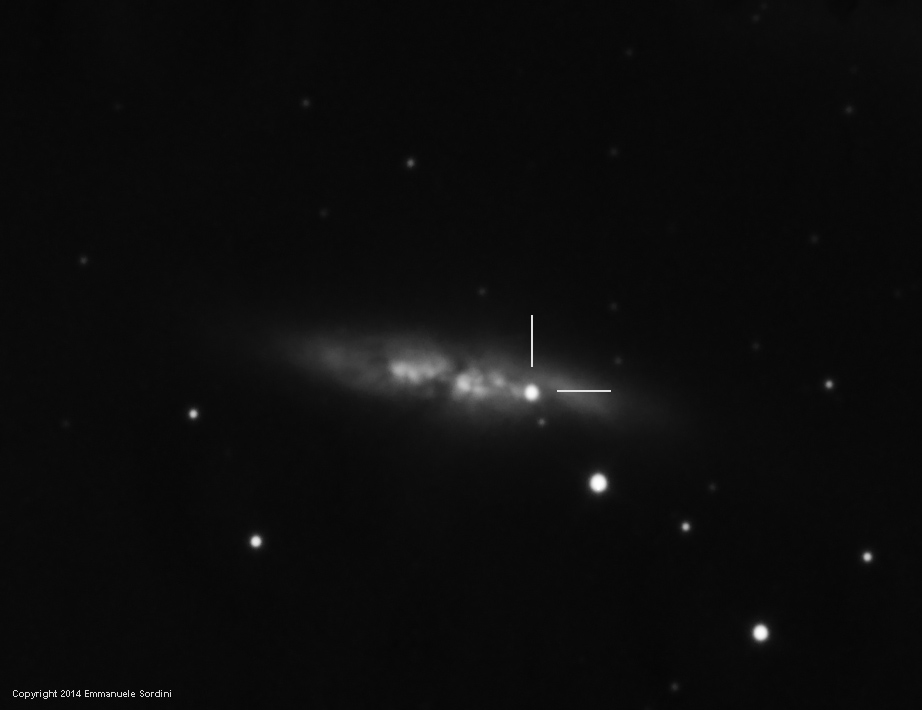
On January 21st, 2014, reports began circulating that a new supernova had just been discovered in M82 the Cigar Galaxy, close companion to the more famous Bode Galaxy, aka M81. Unfortunately my aurora-chasing trip to Norway from January 25th to February 1st (of which a detailed report will soon be published on my website) prevented me from spending any time on the observation of this interesting event. After all, this supernova blew up in a relatively nearby galaxy! Imaging the […]

During the last bit of 2013, comet ISON was not the only comet visible Thank God, I’d say, because ISON turned out to be a real dud. Around late November there were four comets visible in the sky at the same time, the brightest of the pack being Comet C/2013 R1 Lovejoy, that went on to put on a really good show. Discovered on September 7 by Australian amateur astronomer Terry Lovejoy, this comet kept visible during the second half […]

Discovered in September 2012 by two Russian Astronomers (Vitali Nevski and Artyom Novichonok) with the 40-cm reflector of the International Scientific Optical Network (ISON) at the Observatory of Kislovodsk (Russia), this comet soon catches the attention of the scientific community, because its perihelion is expected very close to the scorching solar surface at 0.012 AU, i.e. less than 2 million km. From the comet’s path and brightness curve in the months following its discovery, some people suggest that it might […]

Ok, I made it! Here you go this is my first real update to my website. It’s kind of an off-season picture, as the target M8, aka the Lagoon Nebula is a typical summer object. To me it’s very important, not only because it’s my first real update, but because it is my attempt at improving my image processing skills, after attending an image processing course held by my good friend Lorenzo Comolli. The picture shown here has been processed […]
